Wen’s Accidental Death in the Gunfight
The Cabin at the End of the WorldWen’s Accidental Death in the Gunfight is the turning point in the cabin confrontation: while Andrew and Leonard struggle over a gun, Wen tries to protect Andrew, and the weapon fires accidentally. Her death changes the family’s immediate crisis into a question about whether an unintended loss can satisfy the visitors’ demand for a willing sacrifice.
The struggle for the gun
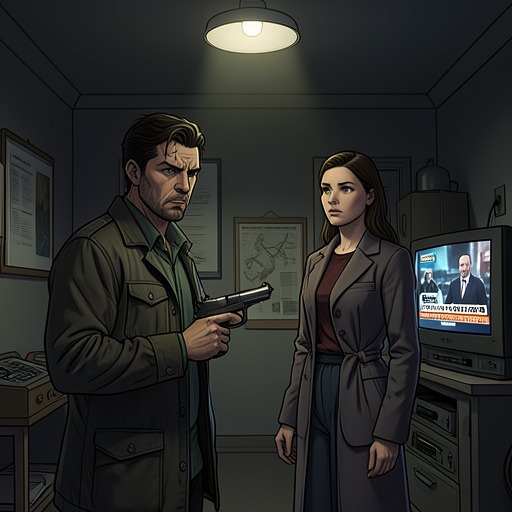
Wen is beside the struggle as Leonard, much larger than Andrew, presses him against a cabin wall. Both men’s hands are wrapped around the gun, and their efforts to control it leave the weapon caught between them. Leonard’s size and strength give him the advantage; Andrew is tiring and struggling to push him away. Wen calls on Leonard to stop because he is hurting Andrew, while Eric is still working free of the rope and chair nearby.
Andrew drops to his knees, a move that throws Leonard off balance and brings the side of Leonard’s head against the wooden wall. Leonard recovers and continues trying to wrench the gun free. The struggle has shifted suddenly: Andrew’s maneuver interrupts Leonard’s hold, but neither man has secured the weapon. Wen is still close enough to witness the confrontation when her perception abruptly ends.</body_en
The accidental discharge and immediate aftermath
The gun fires while Leonard and Andrew are still struggling over it. Leonard later recalls that Andrew’s sudden drop had thrown him off balance and that he was angry when he resumed trying to take control of the weapon. As their hands remained together around it, Leonard felt the trigger move; only after the shot did he understand what had happened. He had not been looking directly at Wen, but he saw her fall. The sequence makes the death accidental: neither man had chosen Wen as a sacrifice, and the immediate cause was the gun going off during their struggle.
The struggle gives way to the family’s grief. Andrew and Eric gather around Wen’s body, holding and shielding her as their cries become undifferentiated screaming. Leonard, apart from them, remains on the floor and cannot bring himself to look at her. He repeatedly apologizes, in speech and in his thoughts, while condemning himself as a failure. His reaction contrasts with the anger that preceded the shot: the man who had been trying to overpower Andrew now understands himself as responsible for a loss he did not intend.
The death does not resolve the visitors’ demand. Leonard explains that they had required Andrew and Eric to choose a willing sacrifice; the group had been forbidden to sacrifice either man themselves. Because Wen’s death was an accident and no one chose it, Leonard cannot tell whether it will be accepted as sufficient. He urges the others to check the television for evidence that the expected catastrophe has stopped, but admits that he does not feel the crisis is over. Andrew places Wen’s body on the couch and leaves his hand on her covered head, while the family’s immediate loss remains entangled with the unresolved threat beyond the cabin.
A break in perspective
The scene’s abrupt change in focalization makes its uncertainty part of the event’s form. Wen’s perception ends during the struggle; the account then moves into Leonard’s experience, where the trigger’s movement becomes a dividing point between what he remembers before the shot and what he understands afterward. This shift gives the reader access to Leonard’s dawning recognition without supplying an independent view of the instant itself. The death is therefore presented through a gap in perception and a belated understanding, rather than through a fully observed moment.
The unresolved test
Leonard’s explanation exposes the gap between Wen’s importance to the family and the visitors’ rule for the sacrifice. He insists that Wen matters profoundly, but says the demand had required Andrew and Eric to choose someone willing; neither parent had chosen her, and her death occurred by accident. He therefore cannot say whether it will count. The distinction offers no comfort: it makes the family’s loss immediate while leaving its supposed purpose unsettled.
The television becomes the proposed means of testing whether the catastrophe has been stopped, but the scene supplies no confirmation. Eric prays for help and senses that the threat remains present at the cabin’s entrance; Leonard, too, admits that the crisis does not feel finished. The event thus closes not with an answer but with a suspended test: Wen is dead, while the rule that was meant to give her death meaning remains uncertain.